Âé¶¹Çø

Top
Skip to Content
LOGO(small) - Queen's University Belfast
LOGO(large) - Queen's University Belfast
Queen's Business School
  • Home
  • Âé¶¹Çø
    • Mission, Vision, Values
    • Accreditation and Reputation
    • Ethics, Responsibility and Sustainability
    • Diversity, Equity, Inclusion and Belonging
    • QBS Student Hub
    • Why Choose Queen's Business School?
    • News
    • Events
    • Contact Us
  • Study
    • Undergraduate Study
    • Postgraduate Taught Study
    • Postgraduate Research Study
    • MBA (Master of Business Administration)
  • Student Opportunities
    • MBA Mentoring for Students
    • QBS Connect
    • Secure a Placement
    • Year in Enterprise
    • Highered
    • Data Duo Mentoring for Students
    • Future Ready Award
    • Join A Society
    • FinTrU Trading Room
    • Student Managed Fund
    • Student Experiences Blog
    • 2025 Prize Giving
  • Research
    • Academic Departments
    • Research Centres and Initiatives
    • Research Environment
    • Research Impact
    • Research Staff
    • Find a PhD Supervisor
    • Seminars
    • Working Papers
    • REF 2021
    • 3MT at QBS
  • Business Hub
    • Mentor an MBA Student
    • MSc AI in Business Internships
    • Business Clinic
    • QBS Business Breakfast Events
    • Recruit a Placement Student
    • Queen's MBA
    • QBS Analytics Lab
    • Data Duo Mentoring for Professionals
    • Recruit Student Talent
    • Recruit an MAcc Advanced Accounting Placement Student
    • Give Back to QBS
    • Good Business Podcast
    • Case Studies
    • Innovative Ideas
    • Contact Business Hub
  • International
    • Come to Queen's
    • Go Abroad
    • Visiting Scholars
    • Global Partnerships
    • International Student Testimonials
    • Offer Guide for International Students
    • Prodigy Finance Loans
    • QBS Summer School
  • People
    • Key Contacts
    • Academic Staff
    • Professional Services Staff
    • Research Students
    • School Advisory Board
    • Honorary Staff
  • Alumni
    • Update Your Details
    • Benefits
    • Stay Connected
    • Get Involved
    • Alumni Stories & Profiles
    • News & Publications
    • Events
    • Executive Education
    • Support the School
    • Contact Us
    • Congratulations Class of 2025
  • Home
  • Âé¶¹Çø
    • Mission, Vision, Values
    • Accreditation and Reputation
    • Ethics, Responsibility and Sustainability
    • Diversity, Equity, Inclusion and Belonging
    • QBS Student Hub
    • Why Choose Queen's Business School?
    • News
    • Events
    • Contact Us
  • Study
    • Undergraduate Study
    • Postgraduate Taught Study
    • Postgraduate Research Study
    • MBA (Master of Business Administration)
  • Student Opportunities
    • MBA Mentoring for Students
    • QBS Connect
    • Secure a Placement
    • Year in Enterprise
    • Highered
    • Data Duo Mentoring for Students
    • Future Ready Award
    • Join A Society
    • FinTrU Trading Room
    • Student Managed Fund
    • Student Experiences Blog
    • 2025 Prize Giving
  • Research
    • Academic Departments
    • Research Centres and Initiatives
    • Research Environment
    • Research Impact
    • Research Staff
    • Find a PhD Supervisor
    • Seminars
    • Working Papers
    • REF 2021
    • 3MT at QBS
  • Business Hub
    • Mentor an MBA Student
    • MSc AI in Business Internships
    • Business Clinic
    • QBS Business Breakfast Events
    • Recruit a Placement Student
    • Queen's MBA
    • QBS Analytics Lab
    • Data Duo Mentoring for Professionals
    • Recruit Student Talent
    • Recruit an MAcc Advanced Accounting Placement Student
    • Give Back to QBS
    • Good Business Podcast
    • Case Studies
    • Innovative Ideas
    • Contact Business Hub
  • International
    • Come to Queen's
    • Go Abroad
    • Visiting Scholars
    • Global Partnerships
    • International Student Testimonials
    • Offer Guide for International Students
    • Prodigy Finance Loans
    • QBS Summer School
  • People
    • Key Contacts
    • Academic Staff
    • Professional Services Staff
    • Research Students
    • School Advisory Board
    • Honorary Staff
  • Alumni
    • Update Your Details
    • Benefits
    • Stay Connected
    • Get Involved
    • Alumni Stories & Profiles
    • News & Publications
    • Events
    • Executive Education
    • Support the School
    • Contact Us
    • Congratulations Class of 2025
In This Section
  • Mission, Vision, Values
  • Accreditation and Reputation
  • Ethics, Responsibility and Sustainability
  • Diversity, Equity, Inclusion and Belonging
  • QBS Student Hub
  • Why Choose Queen's Business School?
  • News
  • Events
  • Contact Us

  • Home
  • Queen's Business School
  • Âé¶¹Çø
  • News

News

Research Investigates Why Energy Companies are Making Profit Despite UK Windfall Taxes

8 February, 2023

This article was first published by Dr Karolis Matikonis on The Conversation.

800 Offshore Oil

Russia’s invasion of Ukraine last year caused , triggering  in many countries, including the UK.

To pay for support for households and businesses experiencing this energy price crisis, the government introduced an additional 25%  from 26 May 2022. This was increased again in the 2022  to 35% from January 1 2023. Proposals were also put forward for a separate 45% .

But recent bumper earnings announcements from large oil and gas companies have called into question how effective these taxes really are.

In 2022,  annual income to shareholders increased by 211% from US$20 billion (£16.5 billion) to US$42 billion. Similarly,  reported a 215% rise in profits to US$28 billion, from US$13 billion in 2021. But the UK taxes these companies pay are extremely small compared to the overall amount they pay globally.

Over the winter months, ongoing media reports have detailed how many . This raises questions of fairness and has led to  for  in  for these companies.

But  into the UK taxes these companies pay versus the profits they are making right now shows that even larger windfall taxes for energy companies may not make a massive difference to the amounts generated from .

It’s possible to get some idea of this by broadly comparing Shell and BP’s reported profits with their tax contributions. The chart below shows the ratio of taxation to revenue paid by these companies between 2019 and 2022. There have been substantial fluctuations across the years, including a significant jump between 2021 and 2022, suggesting these companies did pay more tax in 2022 – after the 25% windfall tax was introduced.

Revenues made versus taxes paid globally
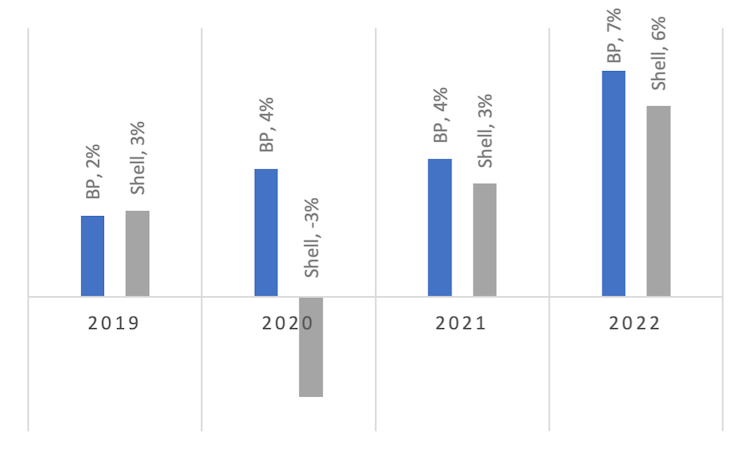
Bar chart showing the ration of taxes paid to revenues reported by BP and Shell from 2019 to 2022. As described in the paragraph above, there has been a significant rise in 2022.

But it would be wrong to attribute this change to the introduction of this windfall tax in the UK. Although Shell and BP have headquarters in London, they are multinational companies operating in many countries with different fiscal regimes.

UK operations accounted for  of BP’s total revenues from oil and natural gas exploration and production activities in 2021, while Shell’s revenue share was  for the whole of Europe. (BP’s financial statements include separate figures for UK, while Shell reports only European figures.)

The tax collected by the UK government doesn’t even come close to these companies’ total global taxes. BP paid the UK  (US$302 million) of its US$6 billion global tax contributions from oil and natural gas exploration and production activities in 2021, while Shell’s tax contribution in Europe was  – or US$473 million of its global US$7.5 billion tax contributions.

Of course, we are still talking about substantial amounts of money. But the income from these levies is unlikely to be enough to offset the £69 billion the UK is likely to spend on energy support schemes.

Tax breaks

Historically, tax collections from oil and gas producers look quite low compared to their revenues. This chart provides an idea of the vast difference over time:

Tax collected versus revenues from oil and gas extraction in the UK
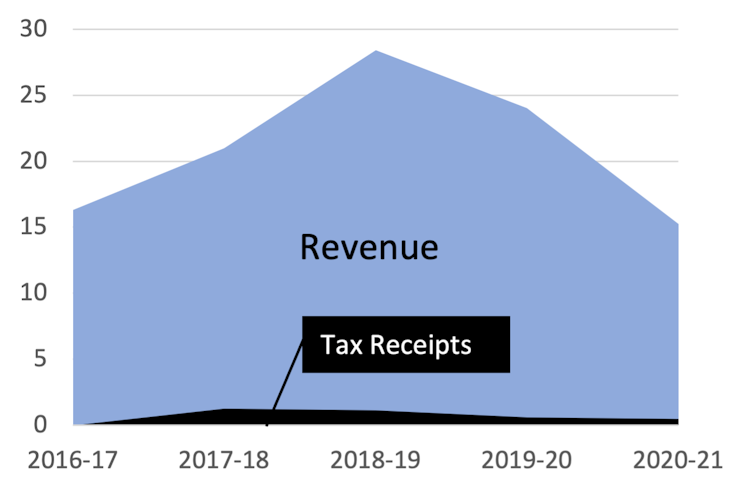
Chart depicting tax receipts versus revenues reported recently by BP & Shell, as described in the paragraphs above and below.

This is primarily because of  from the UK government. The tax regime for oil and gas production differs from standard corporate taxation in the UK. Companies are liable to higher tax rates and it is “ring-fenced”. This means the extraction of gas and oil is .

So, if such a company makes £100 million in taxable profits from oil and gas extraction in the UK, on paper it would be liable to pay £40 million in ordinary taxes and a further £35 million under the oil and gas levy (after the uplift from 1 January 2023).

The oil companies can be exempt from this liability completely through reliefs and allowances. If this company chooses to invest all its profits (£100 million) in more extraction activities, it would not have to pay £75 million and would receive further allowances to offset future profits the following year, which would total £16.4 million – or even £34.25 million if it invests these profits in decarbonisation activities.

Furthermore, these allowances are not built into the , showing that the UK government prioritises continued extraction of oil and gas in favour of renewable energy –  in an upcoming paper on this topic.

Why use windfall taxes?

Although there have been many academic studies examining the effects of windfall taxes, the structure of these taxes can differ. As such, there are  on whether current levies on oil and gas producers actually work.

Having said that, many experts are against one-off windfall taxes because they could distort a company’s investment decisions (by making other, unaffected parts of the business seem more attractive) and can also increase risk for investors. This is supported by evidence from the UK, where former prime minister Tony Blair’s windfall tax on privatised utility companies was found to have a negative impact on investor confidence and caused these firms to .

So, it might wiser for the UK to move away from hastily introduced windfall taxes towards a more  that would help achieve energy security through fiscal stability instead of costly tax allowances and reliefs.


Click to view this article on The Conversation.


Photo: Dr Karolis Matikonis
Dr Karolis Matikonis
Lecturer in Information Technology, Analytics, and Operations (ITAO)
Share
Latest News
  • Winners of ‘Award for Diversity and Inclusion’ Presented by QBS
    18 March, 2026
  • EGOS Colloquium 2026: Queen’s Business School Local Hub
    6 March, 2026
  • Young Business Talent Shines at NI Schools’ Business Challenge
    22 February, 2026
  • Queen’s Business School Continues as a PRME Champion Institution for 2026-2027
    23 January, 2026
  • Opportunities for Your Business In January 2026
    14 January, 2026
Âé¶¹Çø
  • Âé¶¹Çø
  • Mission, Vision, Values
  • Accreditation and Reputation
  • Ethics, Responsibility and Sustainability
  • Diversity, Equity, Inclusion and Belonging
  • QBS Student Hub
  • Why Choose Queen's Business School?
  • News
  • Events
  • Contact Us
QUB Logo
Contact Us

Queen's Business School
185 Stranmillis Road
Belfast
Northern Ireland
BT9 5EE

Contact details

Quick Links

  • Home
  • Study
  • Research
  • Social media


AACSB logo


PRME logo


© Queen's University Belfast 2024
  • Privacy and cookies
  • Website accessibility
  • Freedom of information
  • Modern slavery statement
  • Equality, Diversity and Inclusion
  • University Policies and Procedures
Information
  • Privacy and cookies
  • Website accessibility
  • Freedom of information
  • Modern slavery statement
  • Equality, Diversity and Inclusion
  • University Policies and Procedures

© Queen's University Belfast 2024

Manage cookies